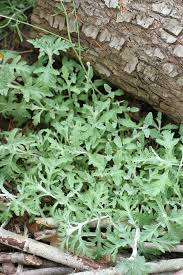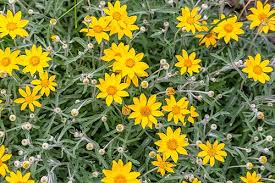
This month’s featured native is the aptly-named Oregon sunshine (Eriophyllum lanatum), a low-growing ground cover that brightens the sometimes rainy days of a Pacific northwest spring. A perennial herb in the aster family, Oregon sunshine varies in height from 10 – 60 cm (4 – 24″), with a spread to match; the variability stems from the plant’s propensity to survive in a wide range of habitats (tougher conditions = smaller plants). The deeply-lobed foliage is covered in fine, white hairs, lending a greyish cast to the leaves that contrasts nicely with the plant’s vibrant flowers. Blooms are bright yellow mini-sunflowers, generally 2.5 – 5 cm (1-2 in) across, and are composed of 6-14 ray flowers (the part that looks like petals) and several disk flowers (the small, tubular flowers in the middle). These appear from May to August in our area, succeeded by smooth, dark-brown to black seeds.
Oregon sunshine is very drought-tolerant once established; it will actually resent summer watering except in exceedingly well-drained soil. It is native to the west coast of North America, spanning from British Columbia south through California, and inhabits dry, open places, as well as rocky slopes and bluffs.
A huge array of pollinators–including sweat bees, mason bees, hover flies, and mining bees–enjoy the flowers, which also serve as a nectar source for the endangered Fender’s blue butterfly. Oregon sunshine is also a host plant for the larvae of several other butterfly and moth species. Have a hard-to-water spot with good drainage that needs a splash of color? This might be just the plant for you!