
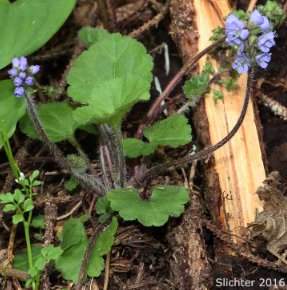
This month’s featured native: spring queen (Synthris reniformis; also Veronica regina-nivalis in some taxonomies)
Amid the heavy duff of a Pacific northwest forest understory, the observant hiker might spy the inconspicuous flowers of spring queen (also called “snow queen,” since it often pokes up so early in the season). Generally growing no more than about 15 cm (6″) tall, this common member of the figwort family (Scrophulariaceae) can be hard to spot, but is a sure sign that spring is nigh. Its basal, heart-shaped leaves have jaggedly toothed margins, and measure up to 8 cm (3″).
Like their petioles, they are sparsely covered with shaggy hairs. The leafless flower stalks are similarly hairy, and produce a terminal cluster of bell-shaped, four-lobed, blue-violet flowers, each about 1 cm (1/2″) long. These give way to two-seeded capsules once pollinated.
Spring queen grows in coniferous forests and forest edges. Its early bloom time makes it an important pollen and nectar source for “early rising” insects…and a gentle reassurance that winter is nearing its end!