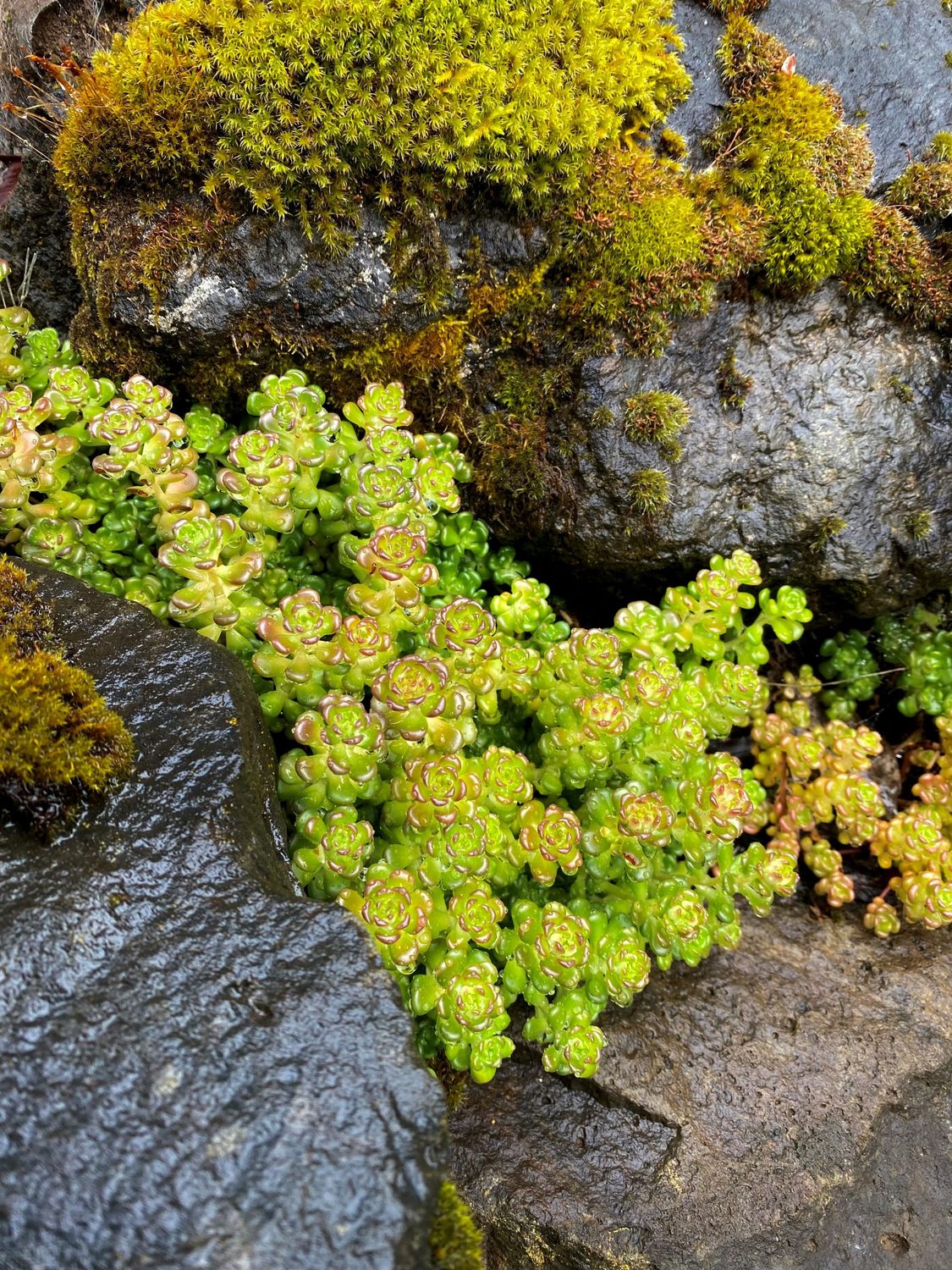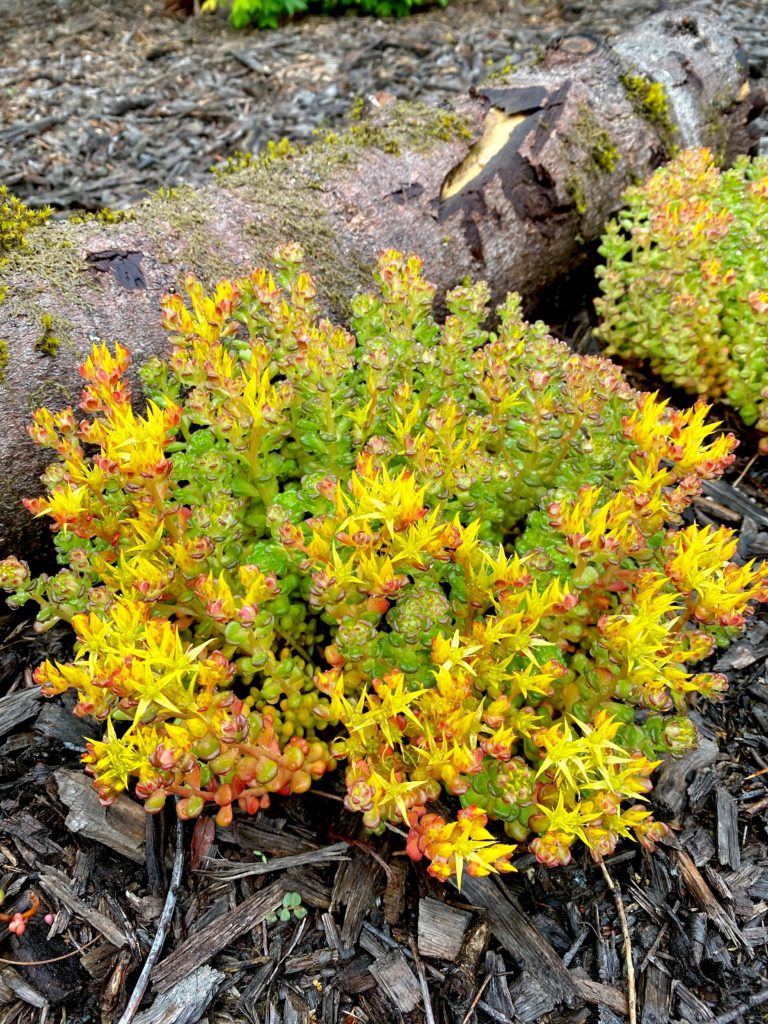
As the last of the leaves fall from our region’s deciduous plants, the backyard garden can become a drab, featureless landscape. Yet fear not, gentle reader! For the Portland area has not one, but two native stonecrop species (Family: Crassulaceae) that provide year-round interest and habitat value. (I’ll save a write-up on the second of these for another time, since it’s hard to find plants to write about in the winter months!) Oregon stonecrop (Sedum oreganum) is a perennial, spreading succulent, reaching only about 15 cm (6″) in height but spreading to twice that or more. Its 1 – 1.5 cm (1/2″ – 3/4″) leaves grow in tight rosettes, and change color throughout the year, moving from vibrant green in spring and early summer to red-burgundy hues during droughty summer-fall and winter dormancy. Its flowers are little yellow 5-petaled explosions, clustered on stalks that double the plant’s height in July and August. The fruit then forms after pollination as small, upright follicles.
Oregon stonecrop can reproduce both by seed and by vegetative propagation. In fact, not only will it readily spread on its own, but cuttings or even individual leaves will often root and grow, making this an easy plant to propagate in the home garden. It prefers full sun, but will tolerate some shade; its main requirement is well-drained soil. As the name implies, Oregon stonecrop is mainly found rocky outcrops, gravelly soils, and slopes; it makes an excellent addition to green roofs or rock gardens, or any portion of the yard with dry soil. Native butterflies and bees utilize the nectar from the flowers; the plant is also a larval food source for these animals, a caterpillar host plant, and attractive to a variety of beneficial insects. Winter shows us where the bare spots are; if you’ve got one with good sun and drainage, this is a great plant to fill it in!