
This month’s featured native: grand fir (Abies grandis)
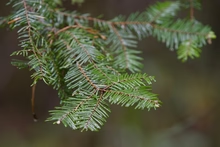
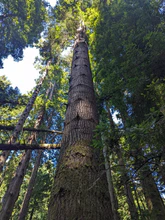
Grand fir earns its common name by its tall, stately growth habit, reaching up to 80 m (250 ft). Its needles grow in two distinct rows, and–uniquely among local conifers–are splayed out flat, so that both the top and bottom of its branches are readily visible. They are dark green on top with a groove down the middle; the underside features two white lines. These are the tree’s stomata, which open and close to enable photosynthesis. Unlike the more-common Douglas fir, this is a “true” fir, with its yellow-green cones standing erect on upper branches, 5-10 cm (2-4 in) tall.
Like other true firs, grand fir has very thin bark, leaving it vulnerable to fire; suppression of fire activity over the last century has allowed it to become a more common component of local forests, where it typically grows under Douglas fir canopy. It grows chiefly in rainshadow areas at low to middle elevations.
In addition to its noble appearance, grand fir offers a balsamy pungence, and is a fantastic wildlife feature: sapsuckers, deer, and elk eat the foliage, the seeds are a food source for an array of small mammals and birds, and the tree attracts and supports pest-eating insects. It is also a host plant and larval food source for many native moths and butterflies, and provides shelter for dozens of bird and mammal species.
(Both images courtesy of Sparrowhawk Natives)