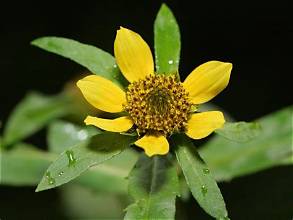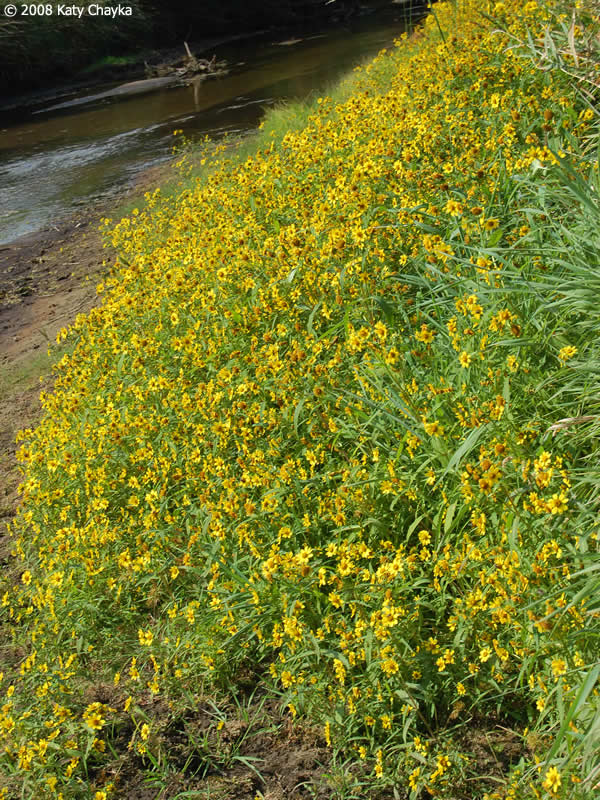
It’s a sunflower! It’s a balsam! NO, it’s…this month’s featured native plant (which is why it’s by the water)! Nodding beggar’s tick (Bidens cernua) is an annual members of the aster family (Asteraceae). Reaching up to 1 m (3 ft) in height, with opposite, saw-toothed leaves, this species is fairly inconspicuous until bloom time. Vibrant yellow flower heads appear individually at the ends of the stalks, each with 6-8 rays surrounding a central disk. As the season progresses, these begin to droop, giving it the “nodding” moniker (as well as its Latin species name “cernua,”). The narrowly triangular seeds (achenes) feature prominent barbs in pairs (whence Bidens, “two teeth”), an ingenious means of sticking to passing deer, or to that pair of jeans you wore to go frog-watching.
Beggar’s tick reproduces by seed, and grows best in full to part sun, in moist to wet soil; it is always found near water, and often emerges late in the growing season as ponds and wetlands dry out before the fall rains arrive. It is widely distributed across North America, as well as much of Asia and Europe. Beggar’s tick is an important wildflower for native bees.