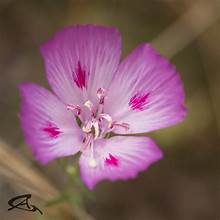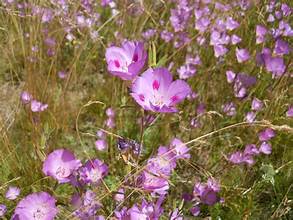
This month’s featured species has been saddled with a slightly melancholy moniker, owing to the timing of its bloom: farewell-to-spring (Clarkia amoena) opens its pink, cup-shaped blossoms just as summer begins. (Why not “Hello-to-summer?”) This annual beauty can reach up to nearly a meter (3 ft) in height, with slender stalks culminating in one or a few showy, four-petaled blossoms. If planted in a suitable area, farewell-to-spring will readily self-sow its brown-black seeds, allowing it to persist for multiple years.
Farewell-to-spring grows best in full to part sun, with well-drained soil. It is drought-tolerant once established. Farewell-to-spring’s native range goes from British Columbia south to California, between the Pacific coast and the lower Cascade mountains. It grows mainly in meadows and vernal wetlands.
The flowers of farewell-to-spring are a favorite of hummingbirds, and also attract and support many different bee species, including honeybees, native bumblebees, leaf-cutter bees and mason bees, as well as butterflies. Pollinator support and a show-stopping floral display; not a bad way to welcome summer!